Comparisons
Apple Watch Series 11 vs Garmin Venu 3: smartwatch or sports watch
These two watches are not rivals so much as different answers to the same question: do you want a phone on your wrist, or a coach that lasts a fortnight?
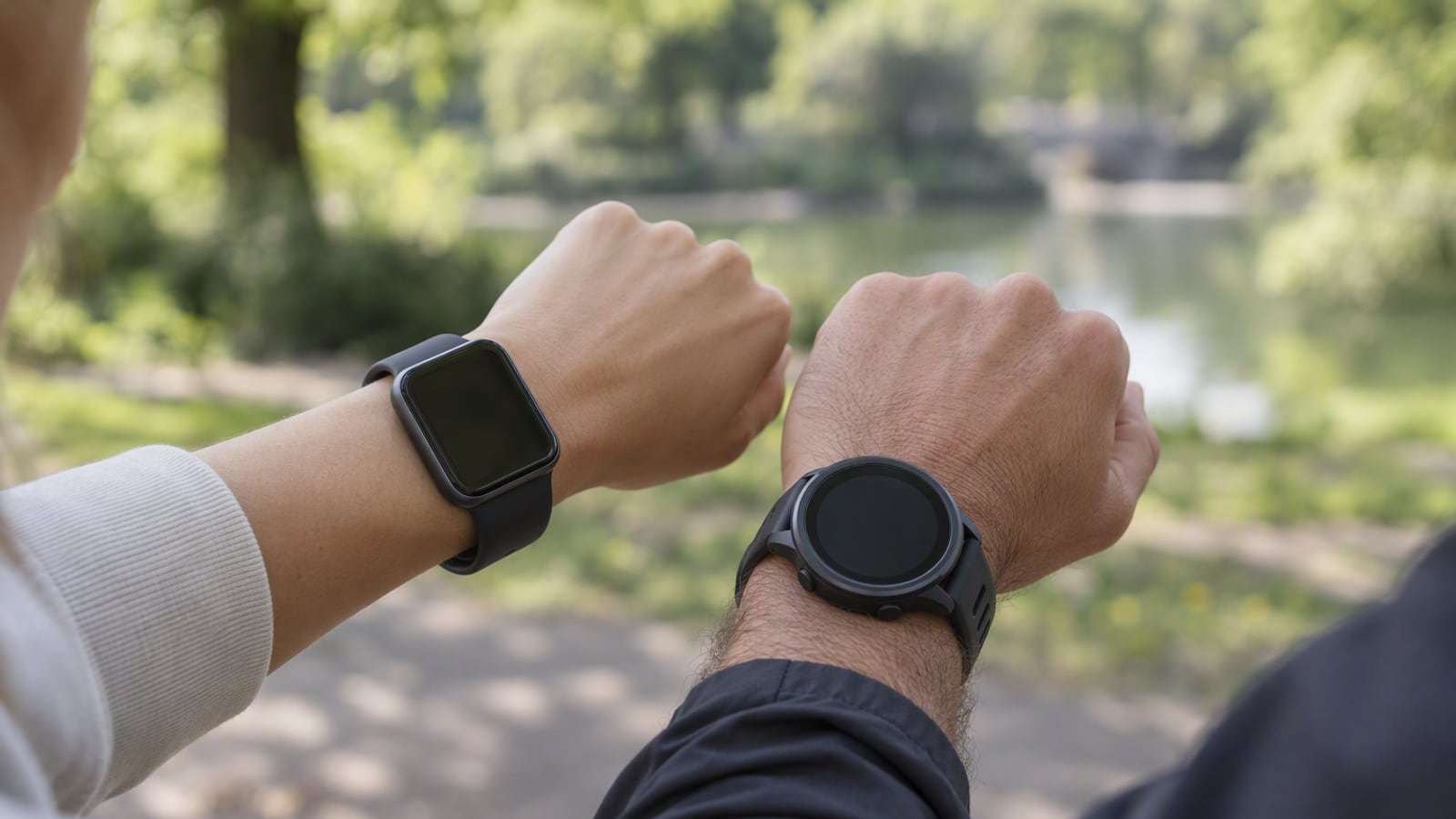
Picture two people at the start of a Saturday morning parkrun. One is checking a message on a square-faced watch and tapping to pay for a coffee afterwards. The other wears a round watch that will not need charging until next week. Both are getting what they wanted.
That is the real shape of the choice between the Apple Watch Series 11 and the Garmin Venu 3. It is not a fight over which is better, because they were built for different people: one is a smartphone extension that also tracks fitness, the other a fitness and recovery device that also shows notifications. This comparison uses published specifications and the consistent themes in owner reports. We have not worn either watch and we have not measured anything.
The short verdict
Buy the Apple Watch Series 11 if you own an iPhone and you want a smartwatch first. The deepest app ecosystem of any smartwatch, health sensors that are useful without a subscription, and replacement bands everywhere make it the most capable wrist computer you can buy. Accept that it needs charging roughly nightly.
Buy the Garmin Venu 3 if you want one watch for training, sleep and daily life, and you refuse to charge nightly. It works properly on both Android and iPhone, its sleep and recovery tracking is the most actionable here, and it lasts up to 14 days per charge. Accept that there is no LTE option and that it is not as rugged as a dedicated sports watch.
If you are training for a race specifically, the Garmin Forerunner 265 is the third answer: it trades the Venu’s generalist polish for multi-band GPS and training readiness aimed at runners.
Feature comparison
| Apple Watch Series 11 | Garmin Venu 3 | Garmin Forerunner 265 | |
|---|---|---|---|
| Display | Always-on | AMOLED | AMOLED |
| Battery claim | Roughly a day, so it charges nightly | Up to 14 days per charge (Garmin’s claim) | Up to 13 days per charge (Garmin’s claim) |
| Platform support | Designed for iPhone; most advanced features need one | Works properly on both Android and iPhone | Works on both Android and iPhone |
| Health and training | ECG and blood-oxygen sensors, crash and fall detection | Sleep coach and Body Battery | Training readiness scores and multi-band GPS |
| Best for | Notifications, Apple Fitness users, health and sleep tracking | Mixed training, both phone platforms, sleep tracking that works | Runners and marathon training |
| Main tradeoff | Nightly charging; most advanced features are iPhone-only | No LTE option, and not as rugged as the Forerunner | Smartwatch features are basic, and the app is dense |
Where each one wins
The Apple Watch wins on being a smartwatch
The Series 11 is the most complete wrist computer in this comparison, and it is not close. Apple’s framing is the deepest app ecosystem of any smartwatch, and the practical consequence is that almost anything you would want to do on a wrist has an app for it. Notifications, payments and messages all feel finished rather than bolted on.
The health hardware is the second win. ECG and blood-oxygen sensors, plus crash and fall detection, are useful without a subscription — a meaningful distinction from rivals whose best insights sit behind a monthly fee. The always-on display and 50-metre water resistance round out a device built to be worn through everything, including a swim. Its costs are just as plain: roughly a day of battery, so it charges nightly, and most advanced features require an iPhone.
The Garmin Venu wins on endurance and platform neutrality
The Venu 3’s headline is its battery. Garmin specifies up to 14 days per charge, and that figure changes the relationship you have with the watch: it stops being something you have to remember. For anyone who has abandoned a wearable because charging it nightly was one chore too many, this is the feature that matters most.
Its second win is platform neutrality. The Venu works properly on both Android and iPhone, which is rarer than it should be — a great many smartwatches reserve their best features for one ecosystem. The third is recovery data: Garmin’s sleep coach and Body Battery are described by owners as the most actionable in this class. The weaknesses are on the record too: there is no LTE option, and it is not as rugged as the Forerunner line.
The Forerunner 265 wins if you race
The Forerunner does not pretend to be the generalist. Its multi-band GPS holds a lock in city centres where single-band receivers wander, and its training readiness scores are aimed at someone following a plan. For a runner in a marathon block, those two features are worth more than everything else on this page.
The tradeoff nobody mentions
The choice between these watches is really a choice about what you want to be reminded of.
The Apple Watch is designed to be looked at. It surfaces notifications, prompts you to close activity rings, and puts a great deal of information a wrist-turn away. That is useful, and it also means the watch is constantly asking for your attention. Owners who switch away often describe the same thing: they wanted their wrist to stop buzzing.
The Garmin Venu is designed to be ignored. It will tell you how you slept and how recovered you are, then go quiet for days. That is its greatest strength and, for some people, its greatest frustration — if you like the sense of a device actively coaching you, the Garmin can feel passive.
The second tradeoff is subtler: the Apple Watch’s value is partly tied to your phone, because its most advanced features assume an iPhone. The Garmin works with either platform, which makes it the more independent and, in a quiet way, the more future-proof device.
Which should you buy
Buy the Apple Watch Series 11 if you own an iPhone, you want notifications, payments and apps on your wrist, and you value ECG, blood-oxygen and fall-detection features. You should be comfortable charging it nightly, because that is the habit it demands.
Buy the Garmin Venu 3 if you want one watch for training, sleep and daily life, you refuse to charge nightly, and you value sleep and recovery data you will actually act on. It is also the right choice if you are on Android, or if you might switch phone platforms.
Buy the Garmin Forerunner 265 instead if you are training for a specific race. Multi-band GPS and training readiness are the reasons, and they are worth more to a runner than the smartwatch features the Apple Watch does better.
Buy none of them yet if you are still deciding whether you will wear a watch at all. A simple band is the cheaper way to find out.
Frequently asked questions
Which has the better battery life?
Garmin specifies up to 14 days per charge on the Venu 3, while the Apple Watch Series 11 is described in terms of roughly a day. That gap is the biggest practical difference between them, and it changes the habit each device demands: one charges weekly, the other nightly.
Does the Garmin Venu 3 work with an iPhone?
Yes, and that is one of its advantages. It works properly on both Android and iPhone, whereas the Apple Watch assumes an iPhone and its most advanced features depend on one. If you might switch phone platforms, the Garmin is the safer long-term choice.
Is the Apple Watch worth it if I mainly want fitness tracking?
If you are on an iPhone and you value notifications, payments and health sensors alongside the fitness data, yes. If fitness is the whole point, a Garmin gives you the training and recovery data without a nightly charge, which is why runners often end up there.
Where does the Forerunner 265 fit in?
It is the runner-specific option. The Forerunner adds multi-band GPS and training readiness aimed at people following a training plan, where the Venu 3 is the generalist and the Apple Watch is the smartwatch. Choose the Forerunner if you race; choose between the other two if you do not.
The products in this article
Destinations and specification notes were last checked on 2026-10-06. Prices change constantly, so always confirm on the brand's own page before buying.
Best smartwatch for iPhone owners
Apple Watch Series 11 Apple
Best for
Verified specifications
- Always-on display
- ECG and blood-oxygen sensors
- Crash and fall detection
- Water resistant to 50m
What works
- The deepest app ecosystem of any smartwatch
- Health sensors that are useful without a subscription
- Replacement bands are everywhere
What does not
- Roughly a day of battery, so it needs charging nightly
- Most advanced features require an iPhone
Best middle ground between smartwatch and sports watch
Garmin Venu 3 Garmin
Best for
Verified specifications
- AMOLED display
- Sleep coach
- Body Battery
- Up to 14 days per charge
What works
- Works properly on both Android and iPhone, unlike most rivals
- Sleep and recovery tracking is the most actionable here
- Two weeks of battery
What does not
- No LTE option
- Not as rugged as the Forerunner line
Best running watch that you charge weekly
Garmin Forerunner 265 Garmin
Best for
Verified specifications
- AMOLED display
- Multi-band GPS
- Training readiness scores
- Up to 13 days per charge
What works
- Genuinely around two weeks between charges in smartwatch mode
- Multi-band GPS holds a lock in city centres
- Training metrics are useful rather than decorative
What does not
- Smartwatch features are basic next to an Apple Watch
- The companion app is dense and takes learning
Sources
More from Wearables
 Wearables
The best fitness tracker for beginners: start with less than you think
The first tracker you buy should be the one you forget you are wearing, not the one with the longest feature list.
 Wearables
Garmin Forerunner 265 review: a running watch for people who refuse to charge a watch nightly
The Forerunner 265 is built for one person in particular: a runner mid-training-block who wants the watch to keep score and then disappear for a fortnight.
 Audio
AirPods Pro 3 vs Sony WF-1000XM5: which earbuds for a genuinely loud commute
Both of these earbuds are excellent, and the choice between them is decided by the phone in your pocket long before you reach the specification table.